







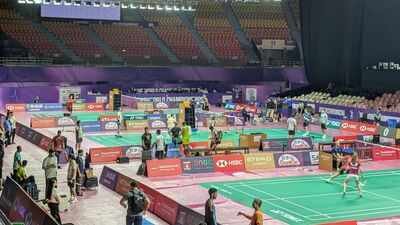
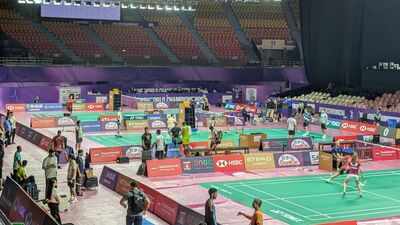
NEW DELHI: At the recently concluded BWF World Championships, players weighed every word as carefully as their drop shots. But beyond the glare of the cameras, another contest was quietly unfolding. Standing a step behind the athletes were the interpreters, almost invisible yet carrying the immense responsibility of ensuring that nuance survived the journey from Mandarin, Japanese or Korean into English.At a World Championships, where every word can travel as quickly as a smash, a mistranslated phrase can soften conviction, distort the meaning of an entire exchange or, in the worst case, trigger an unintended geopolitical controversy. For the interpreters, getting the words right is only part of the job. The real challenge is ensuring that nothing gets lost in translation.Chaavi Raj, one of the three Mandarin interpreters, felt the pressure immediately when local hope Ayush Shetty stunned World No. 1 and defending champion Shi Yu Qi in the opening round.“There was a lot of pressure. There were so many media houses present. My first match was with Ayush Shetty. China lost. It was a big upset,” explained the third-year PhD student in Chinese Studies at Jawaharlal Nehru University.For the 29-year-old Raj, it was a daunting first assignment. He had worked for businesses, exhibitions, tourists and ministries. Sports and media were new territory.
Like India, where there are multiple dialects, Chinese also changes with region, context and tone. It was difficult in the beginning. It is a pictographic language. You have to memorise it. This is the challenge of Mandarin.
Chaavi Raj | Mandarin translator at BWF World Championships
Raj, who hails from Bihar’s Sitamarhi district, has been studying the Chinese language for five years and travelled to Beijing for a visiting scholarship. After his first preference, Spanish, did not materialise, he shifted his focus to Mandarin, graduating in Chinese Language and Culture Studies.“Like India, where there are multiple dialects, Chinese also changes with region, context and tone. It was difficult in the beginning. It is a pictographic language. You have to memorise it. This is the challenge of Mandarin,” he explained.“It is a tonal language. If the tone changes, the meaning changes. It is very easy to forget. It is difficult to memorise. We watch videos to keep ourselves in touch. We watch web series and movies. We talk to our Chinese friends. We do all this to stay in touch with the language,” he added.
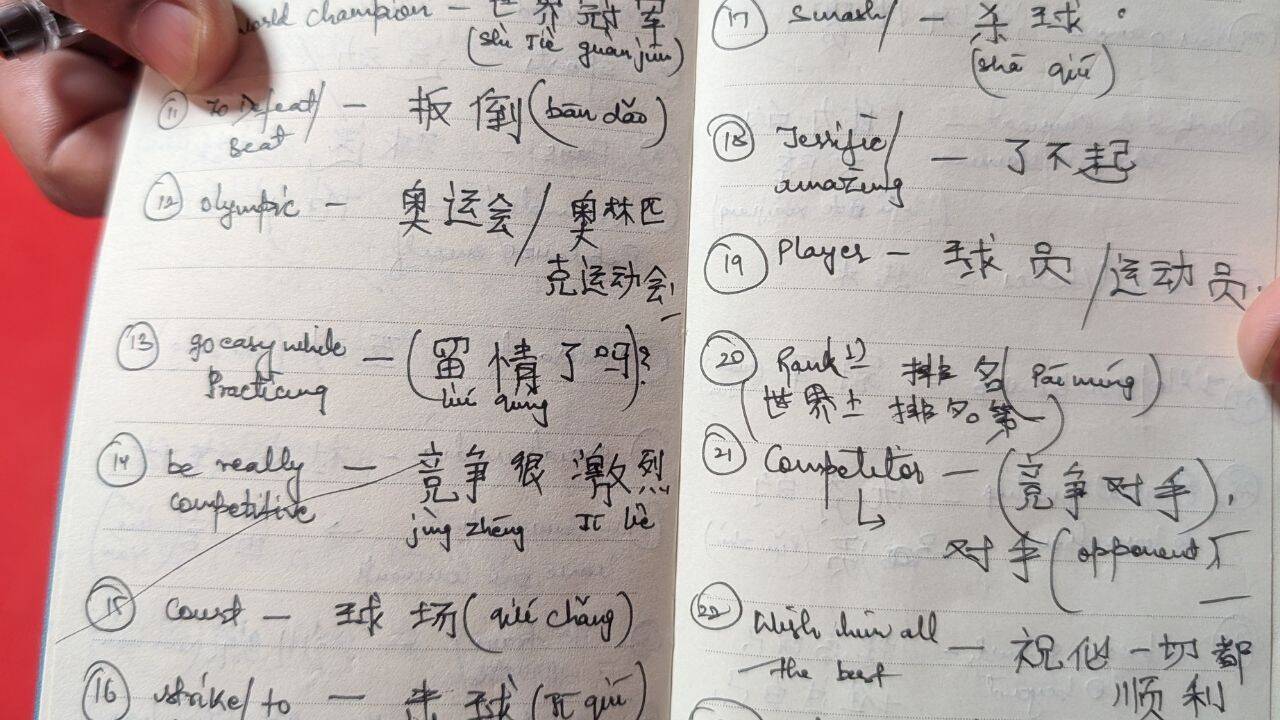
Notebook of the Chinese interpreter. (Special Arrangement)
The BWF brought three interpreters of its own to the tournament, while the Badminton Association of India (BAI) recruited three more through a PR firm and a third-party vendor.Sahin Parween and Nandini were two of the other interpreters roped in by the BAI. Parween, a recent graduate from JNU’s School of Language, Literature and Culture Studies, was first intrigued by Japanese culture while watching animated series such as Doraemon and Shin-chan. Her interest was reinforced later in life as anime found its feet in India. The fact that Japanese is a high-paying language in India has also played a role, she admits almost sheepishly.“We are paid between Rs 4,000 and Rs 10,000 per day. Korean and Japanese generally pay better if you compare them with Western languages. The rate can even go up to $200 (Rs 19,000) or more,” says Parween, who graduated just a month ago.
When we found out the tournament was happening, we searched what it was about. Then we searched for the vocabulary and the questions the media could ask. Then we prepared for what the players could reply to those questions.
Nandini | Korean translator
Like Parween, Nandini’s route to Korean was similarly shaped by pop culture. After picking up the language in 2018, her interest was piqued by K-pop and K-dramas. Perhaps unsurprisingly, language was already part of her life: her father speaks 13 Indian languages.Still relatively new to the profession, the duo spent days training ahead of the World Championships, which returned to India after a gap of 17 years.“When we found out the tournament was happening, we searched what it was about. Then we searched for the vocabulary and the questions the media could ask. Then we prepared for what the players could reply to those questions. Still, there was some nervousness,” explained Nandini, who is a third-year BA student of Korean Language and Culture.Before the World Championships assignment, they would chip in when ambassadors or exchange students visited JNU. Both also make the most of opportunities to meet Japanese, Korean and Chinese people as part of university discussions.
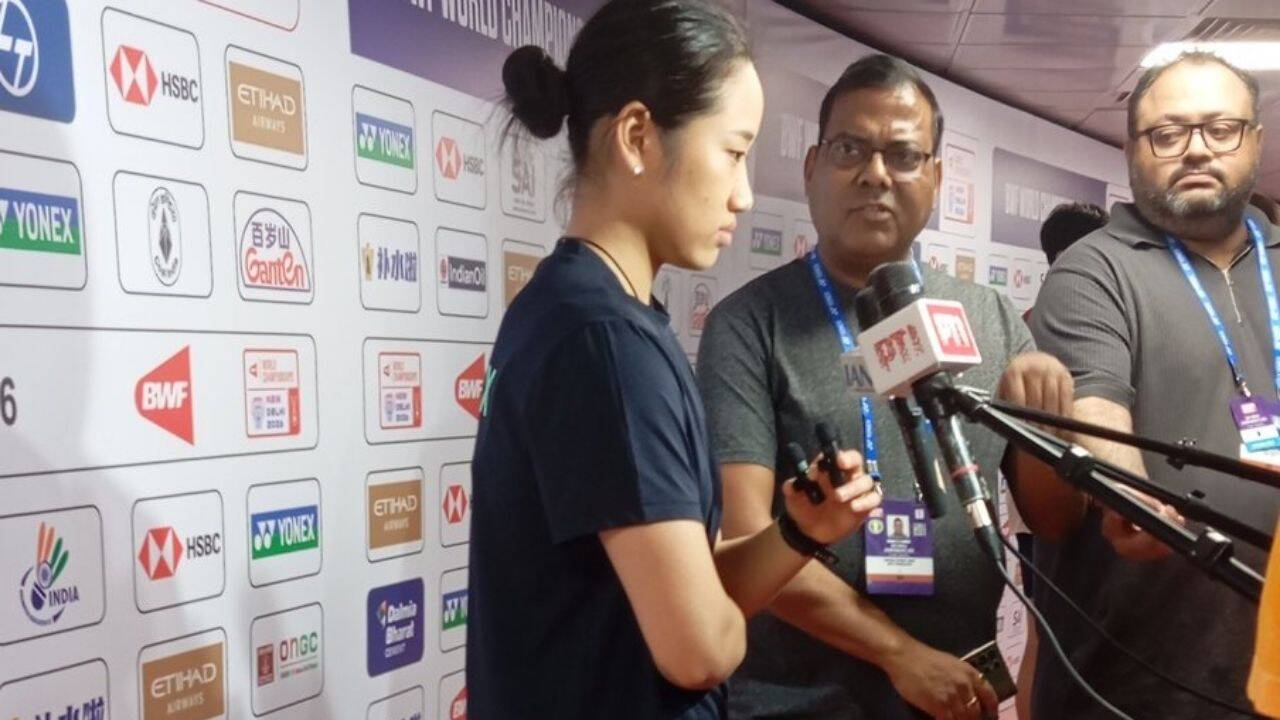
South Korea’s An Se Young speaking to the media after one of her match at the BWF World Championship held in New Delhi. (TOI.com)
This, however, was a different challenge altogether.“There is a lot of pressure when you know that the player is relying on you solely. When the question is asked, they look at our faces, and it’s up to us. And we have to explain it in the right way,” says Nandini.For the youngsters, the pressure was complicated by another fact: they were often interpreting for players they admired.“At the same time, we are also their fans. We just blank out sometimes because we are very busy processing, okay, ‘we are seeing them in real life’. Also, it happens in interpretation that when something is asked or said, we may know the word but we just blank out because of nervousness. So, we find another way to say it,” she said.“There are times when we feel like we could have done better. We have moments where we are unsure of the most appropriate word. But at the end of the day, we are also learning,” she continued.
We see the videos beforehand, the interviews they have given in Chinese. Then we prepare the words. We see which words can be used well. We also take the help of AI. We give prompts asking the tool to go through the videos and suggest which words and vocabulary are repeated most often. Sometimes we write it down, sometimes we make notes.
Chaavi Raj | Mandarin translator
Choosing the right word can be the difference between a routine interview and a diplomatic incident. During the Cold War, disputed translations of Soviet leader Nikita Khrushchev’s remarks and a notorious mistranslation of US President Jimmy Carter’s 1977 speech in Poland became famous examples of how a few misplaced words can distort meaning.Mandarin interpreter Chaavi Raj understands the importance of every word in his preparations. His PhD studies focus on China-US relations and the perception of former American diplomat and Secretary of State Henry Kissinger. He prepares by studying archival footage of the players’ previous interviews. Increasingly, AI tools have become part of that preparation.“We see the videos beforehand, the interviews they have given in Chinese. Then we prepare the words. We see which words can be used well. We also take the help of AI. We give prompts asking the tool to go through the videos and suggest which words and vocabulary are repeated most often. Sometimes we write it down, sometimes we make notes,” Raj explains his process.“It is very important to do it right. In such a big event, where there can be a diplomatic incident, you cannot take a chance,” he says while showcasing his notebook full of Chinese characters, or Hanzi.By the time the last microphone is lowered and the player disappears towards the lounge, the interpreters have already faded into the background. Their names rarely make the broadcast or the byline, yet every headline, quote and television soundbite owes something to their precision. In a sport decided by millimetres, theirs is another game of fine margins: finding the right word, preserving the meaning and making sure nothing gets lost between the player and the world.