







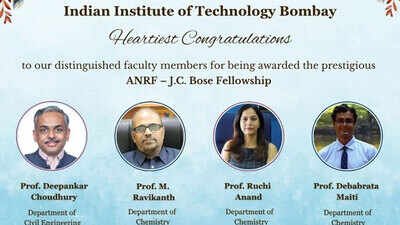
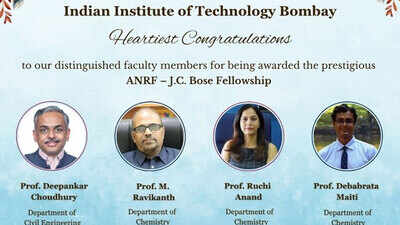
Four faculty members from the Indian Institute of Technology Bombay have been recommended for the prestigious J.C. Bose Grant, one of India’s highest recognitions for active scientists. The institute recently congratulated Prof. M. Ravikanth, Prof. Deepankar Choudhury, Prof. Ruchi Anand, and Prof. Debabrata Maiti after their selection was recommended by the Anusandhan National Research Foundation (ANRF).Formerly known as the J.C. Bose National Fellowship, the five-year grant honours senior researchers who have made sustained contributions to science and engineering while continuing to lead cutting-edge research in India.
From earthquake engineering to drug discovery
The four awardees represent two disciplines—chemistry and civil engineering—but their research spans a remarkable range of real-world applications.Prof. M. Ravikanth from the Department of Chemistry is internationally recognised for his work on porphyrins and macrocyclic molecules, which have applications in chemical sensing, photochemistry and advanced functional materials. A Fellow of the Indian Academy of Sciences and the National Academy of Sciences, India, his research has influenced modern inorganic and supramolecular chemistry.Prof. Deepankar Choudhury of the Department of Civil Engineering is a leading authority in geotechnical earthquake engineering. His work focuses on soil behaviour during earthquakes, foundation engineering and the design of safe, resilient infrastructure. He has also contributed to international design guidelines for combined pile-raft foundations and played a key role in developing India’s engineering code IS: 19117.
Scientists tackling antibiotic resistance and advancing modern chemistry
Among the recipients is Prof. Ruchi Anand, Head of the Department of Chemistry, whose research explores structural biochemistry, biosensors and antibiotic resistance. Using techniques such as macromolecular crystallography, her work helps scientists understand how disease-causing microbes resist medicines, paving the way for improved treatments. She is a Fellow of both The World Academy of Sciences (TWAS) and the Indian National Science Academy (INSA) and has received the National Women Bioscientist Award.The fourth recipient, Prof. Debabrata Maiti, is regarded as one of India’s leading researchers in synthetic organic chemistry. His pioneering work on C-H bond activation has opened new possibilities in pharmaceutical research by enabling chemists to develop complex drug molecules more efficiently. A recipient of the Shanti Swarup Bhatnagar Award, he also serves as Editor-in-Chief of the international chemistry journal Synlett.
What is the J.C. Bose Grant?
The J.C. Bose Grant, administered by the Anusandhan National Research Foundation (ANRF), recognises scientists between the ages of 45 and 65 who have demonstrated exceptional research excellence and continue to make significant contributions to science and technology.The grant provides Rs 25 lakh annually for five years to support research, along with institutional funding to strengthen research infrastructure. Beyond the financial support, it is regarded as one of India’s most prestigious honours for active researchers, recognising both scientific excellence and continued mentorship of the next generation of scientists.With four faculty members receiving this recognition in a single year, IIT Bombay has added another milestone to its long-standing reputation for research excellence, highlighting contributions that range from safer infrastructure and sustainable chemistry to combating antibiotic resistance and accelerating drug discovery.